The Stanley Cup Playoffs have arrived, and with that comes eight incredible first-round matchups to analyze in this space.
We previewed the Eastern Conference action on Wednesday. Today, we turn to the Western Conference, which took until the final day of the regular season to wrap up.

[1] Colorado Avalanche vs. [ WC2] Los Angeles Kings
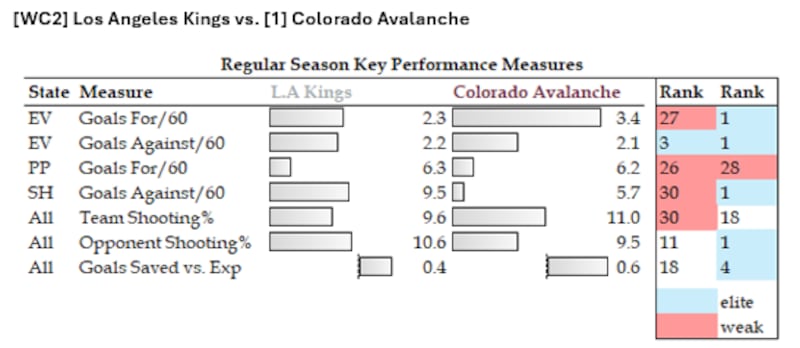
What to Know: The Colorado Avalanche coasted through another stress-free regular season, tearing up the Western Conference en route to another Presidents’ Trophy. A roster teeming with star power, the Avalanche are unquestionably in “Stanley Cup or bust” mode and will begin their quest for a fourth Stanley Cup against a Los Angeles Kings team with heaps of playoff experience – and heaps of problems across the lineup.
The Colorado advantage: You can look at this two ways. The first is that any optimism on the Kings’ side really is about one month of hockey because this Kings team struggled all season long. We are talking about a team that ended the year with a -22 goal differential and just 22 regulation wins, tied with the Chicago Blackhawks for 30th in the NHL. But more compelling is the reality of what this Avalanche team is, and that’s a hockey juggernaut. It’s a freakish combination of top-end star power through guys like Nathan MacKinnon and Cale Makar, backstopped by incredible depth, that allows the Avalanche to comfortably roll four lines and three pairings and makes Jared Bednar’s team so deadly. The average Colorado game saw them winning by 1.2 goals; six players (including MacKinnon and Makar, plus Martin Necas, Brock Nelson, Artturi Lehkonen, and Parker Kelly) scored 20 or more goals; the Avalanche goaltending group finished with a 90.8 stop rate, easily best in the NHL. There are no shortage of metrics that highlight how daunting of a matchup this will be for the Kings, and it’s why oddsmakers have priced Colorado as an 84 per cent favourite to advance in Round 1, way ahead of any other favourite.
The Los Angeles advantage: It’s important to recognize this Kings team is not the same team we saw in the earlier parts of the year. Since turfing head coach Jim Hiller on March 1, Los Angeles is sixth in even-strength goal differential (56 per cent goal share), and it’s in large part due to a coaching decision made by D.J. Smith to load up his top line. Since acquiring Artemi Panarin from the New York Rangers in early February, Panarin, Kempe, and Kopitar have played 330 minutes together at even strength, and to devastating effect. From a talent perspective, it is on the short list of one of the best lines you will find in hockey – elite defensive play down the middle of the ice by way of Kopitar, with two wingers in Panarin and Kempe who are wizards at generating offence from between the circles. Colorado will have its hand full with this group.
Player to watch: This may not have been goaltender Darcy Kuemper’s best season, but he is exactly the type of veteran goalie you want in a series where you know you are undermanned. And he’s a goalie Colorado knows well – it was Kuemper who manned the net for the Stanley Cup-winning Avalanche in 2022, stopping 90.2 per cent of shots faced over the 16-game run.
Pick: This Kings team may be a bit better than what their full-season numbers indicate, but I think they’re in a world of trouble in this matchup. Of note, the aggregate score during their regular-season matchups was 13-5 in favour of Colorado. Avalanche in five.
[1] Vegas Golden Knights vs. [WC1] Utah Mammoth
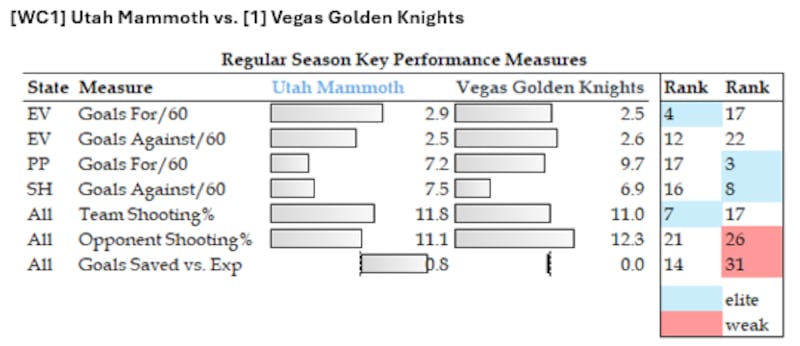
What to know: The Vegas Golden Knights won the Pacific Division title for the fifth time in nine seasons in what can only be described as a “down year” for the organization, which even included a shocking late-season coaching firing. Vegas has been one of the most reliably dominant teams since entering the league in the 2017-18 season through the expansion draft, and their roster is absolutely loaded with playoff experience. They’ll be put to the test in the opening round, drawing a dangerous upstart Utah Mammoth club.
The Vegas advantage: There is an argument Vegas has the best special teams in the NHL; it’s what kept them afloat in an otherwise trying regular season. On the power play, you have three players with hockey IQ pouring out of their ears – Jack Eichel, Mark Stone, and Mitch Marner are on the short list of best playmakers in the game, combining for a whopping 64 assists there. But you also need finishers, and they have two of them in Pavel Dorofeyev and Tomas Hertl, who combined for 33 goals on the man advantage. Marner, Stone, and Eichel just so happen to be elite defensive players as well. You’ll see them regularly on the penalty kill, typically backstopped by Brayden McNabb and Noah Hanifin. Given the personnel, their outperformance on special teams is sustainable, and a series with a lot of penalties called will undeniably play to Vegas’ favour.
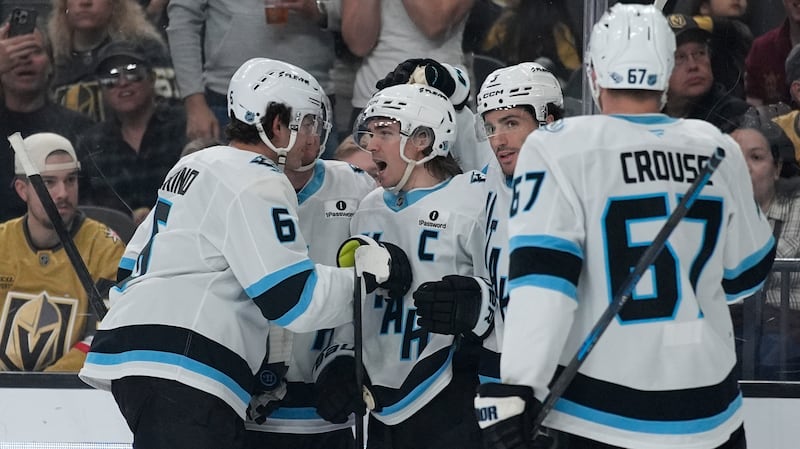
The Utah advantage: If the Golden Knights have been known for one thing over the past decade, it’s an unrelenting forecheck that breaks down even the best playoff teams over the course of a seven-game series. But in this series, there is no doubt who the better even-strength team is, and that’s the Mammoth. Andre Tourigny’s team finished with the fourth-best scoring offence there (2.9 goals per 60), and seventh-best goal differential (+0.45 goals per 60, tied with the Carolina Hurricanes) in the process. What’s scary about this group is they are fast, deep, and come in waves. Clayton Keller’s playmaking (60 assists; 14th in the NHL) turned Nick Schmaltz and Lawson Crouse into dangerous attackers on the top line. Then they come off, and you deal with the dynamic duo of Logan Cooley and Dylan Guenther – the latter so electric this year he crossed the 40-goal threshold. And remember, no defensive pairing in the NHL had more success than veteran staples in Nate Schmidt and John Marino, outscoring opponents 62 to 33 (+29) when deployed.
Player to watch: I’m watching the Vegas crease, in general. The biggest reason the Golden Knights struggled this year was because of shockingly poor goaltending. Adin Hill had a disastrous season (87.1 per cent stop rate), and Carter Hart (89 per cent stop rate) wasn’t much better. The best netminder of the group may have been journeyman Akira Schmid (89.3 per cent stop rate; +8 goals saved versus expected). I expect Hart to be given the starter’s net to open the series, but this may be a game-to-game experience.
Pick: This is the hardest pick of the eight first-round series for me. Vegas’ playoff experience cannot be discounted, but I’ve believed in this Utah team all season long and I can’t stop here. Mammoth in seven.

[2] Edmonton Oilers vs. [3] Anaheim Ducks
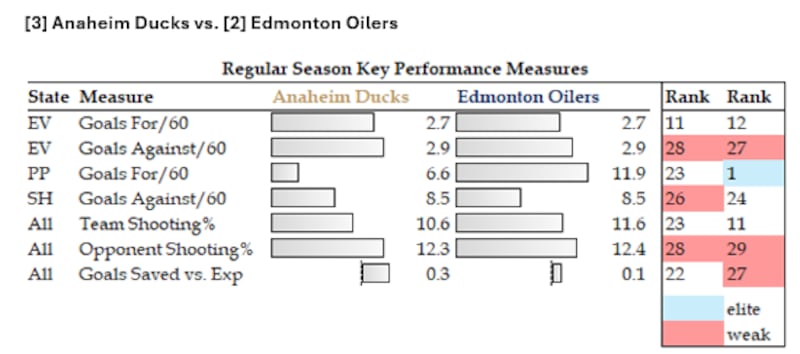
What to know: It’s been a difficult season in Edmonton to say the least – the goaltending position remains of major concern, the lineup is still missing superstar Leon Draisaitl, and they were moments away from being pushed into a gauntlet of a first-round series against the Avalanche until the final day of the regular season. And yet, the Oilers still have the best player in the world at the top of their lineup and a viable path to a third consecutive Stanley Cup Final. It starts against a plucky Anaheim Ducks team returning to the playoffs for the first time since the 2017-18 season.
The Edmonton advantage: With or without Draisaitl in the fold (he’s rumoured to return at some point in the next two weeks), is there a belief Anaheim can stop this turbo-charged Edmonton attack? The Oilers enter this series with, once again, the league’s best power play – Edmonton scored nearly 12 goals per 60 minutes on the man advantage this year, almost double the effectiveness of Anaheim. And they torched this Anaheim team over three games in the regular season, amassing a whopping 16 goals in the process.
The Anaheim advantage: There is a meaningful goaltending disparity between the two sides here. The aggregated numbers for Anaheim understate how solid starter Lukas Dostal was over the course of the year. In 55 appearances, Dostal was 26 goals better than a replacement-level goaltender, stopping 89.0 per cent of shots faced in the process. For baseline purposes, that performance is on par with that of Winnipeg’s Connor Hellebuyck. He has also been fantastic in games against this very Edmonton team; in six starts over the last two seasons, Dostal’s been five goals better than expected, stopping 90.0 per cent of Oilers shots in the process. Of equal importance: the Oilers goaltending situation is on shaky ground at best. Stuart Skinner started the year poorly, culminating in a trade to acquire Tristan Jarry from Pittsburgh, who somehow was worse (85.8 per cent stop rate). That’s paved the way for Connor Ingram to take over Edmonton’s net. He’s done an admirable job picking up the slack, but he’s a journeyman with very limited playoff experience, and at this point a wild card for the Oilers. Anaheim must like the goaltending head-to-head in this series.
Player to watch: Draisaitl’s return may be around the corner, but Zach Hyman is back, and that’s a huge deal for this Oilers team. Hyman amassed 31 goals in 58 games, but more importantly has established chemistry with McDavid.
Pick: Edmonton in six; their goaltending situation remains a question mark, but I have faith in the Oilers’ big guns to overwhelm Anaheim here.

[2] Dallas Stars vs. [3] Minnesota Wild
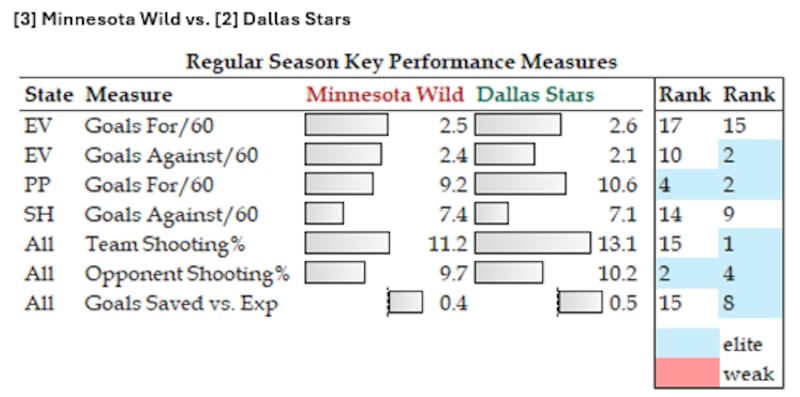
What to know: If it seems like this matchup has been in the cards for months, well, it has, and you can thank the NHL’s bizarre playoff format. Minnesota and Dallas have been two of the NHL’s best teams all season long, but because they happen to play in the same division (and one occupied by the Presidents’ Trophy-winning Colorado Avalanche), their fate in the two-versus-three series was inevitable back in December. Both teams earned an easier path, but that’s moot at this point.
The Dallas advantage: Minnesota is an elite defensive team, but the Stars have shown they are among the NHL’s best at creating dangerous scoring chances. What the Dallas attack lacks in volume (20th in scoring chance rates, 32nd in shot differential) it more than makes up in conversion rates; no team carried a higher shooting percentage this season than Dallas (13 per cent), owing in large part to their ability to create pressure from the inside slot and near the net mouth. What makes this work is having two elite finishers in Jason Robertson and Wyatt Johnston, who combined for 88 goals this season.
The Minnesota advantage: This Minnesota power play is one of the few units in the league that could crack Dallas’ stifling defensive play; the Wild finished the year fourth in rate scoring and are second-best since the turn of the calendar year, averaging 11.6 goals per 60 minutes. Dallas’ penalty kill is nothing to sneeze at, but they’re going to have to figure out a way of dealing with the two-headed monster of Kirill Kaprizov and Matt Boldy, who have combined for 30 power play goals alone this season.
Player to watch: This is an easy one – it’s Quinn Hughes. Perhaps the most prolific offensive defenceman in the league, Hughes has taken so much of the puck-carrying pressure off the forward group, and it’s showing in the numbers. Minnesota’s averaged 3.7 goals per 60 minutes of even-strength play with Hughes on. For baseline purposes, the Avalanche averaged 3.3 goals per 60 minutes this season.
Pick: I like the upset potential here. Minnesota in seven.